


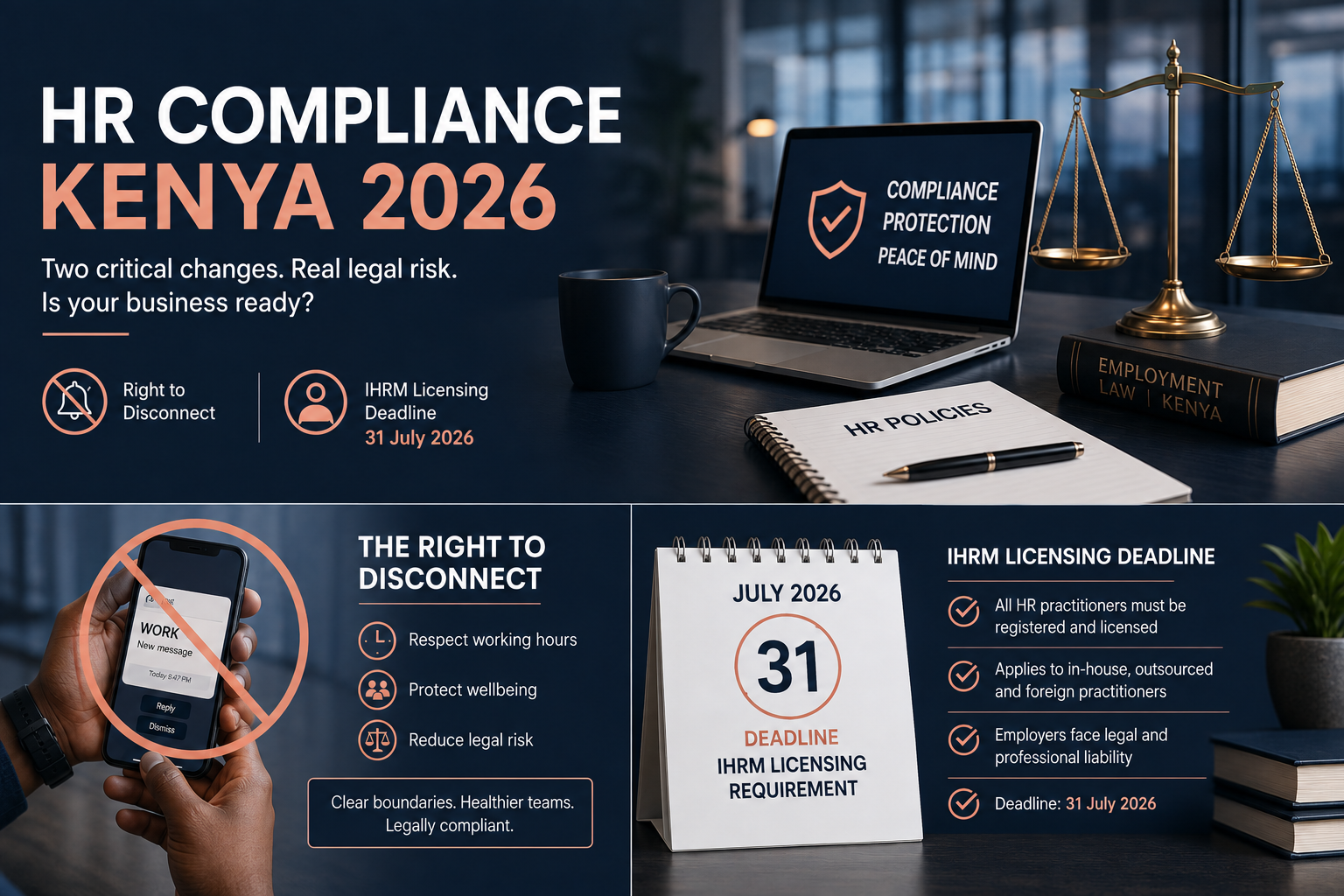
HR Compliance Kenya 2026: Two New Rules Catching Employers Off Guard
Most HR compliance Kenya 2026 conversations focus on payroll — NSSF, SHIF, minimum wage. But two quieter changes this year carry just as much legal risk, and far fewer employers are prepared for them: the Right to Disconnect for remote and hybrid staff, and a hard licensing deadline for HR practitioners themselves.
The Right to Disconnect: A New Legal Boundary on After-Hours Contact
With remote and hybrid work now standard in many Kenyan businesses, 2026 has brought a legal shift: employees are no longer obligated to respond to work-related communication — emails, WhatsApp messages, calls — outside their official working hours, unless it’s a genuine, defined emergency.
This isn’t just a wellbeing recommendation. Employers who don’t respect this boundary are exposed to real legal risk:
- Constructive dismissal claims from employees who can show sustained after-hours pressure
- Overtime pay claims, if after-hours contact is found to constitute additional work
- Disputes over what counts as an “emergency”, if this isn’t defined anywhere in writing
What Employers Need to Do
The practical fix is a written Communication Policy — not a vague expectation, but a documented policy that spells out:
- What counts as an emergency that justifies after-hours contact
- Which roles (if any) are genuinely on-call, and how that’s compensated
- What managers are and aren’t expected to send outside working hours
Without this in writing, a business has no defense if a dispute reaches the Employment and Labour Relations Court.
The IHRM Licensing Deadline: A Compliance Risk for the HR Function Itself

Separately, the Institute of Human Resource Management (IHRM) has set a strict deadline: 31 July 2026, after which all HR practitioners in Kenya — including foreign HR practitioners working locally — must be registered and licensed to practice.
This is not a paperwork formality. Employers using an unlicensed HR manager, whether in-house or outsourced, face criminal liability and professional sanctions — meaning the risk sits with the business, not just the individual HR practitioner.
What This Means Practically
- If you have an in-house HR manager, confirm their IHRM registration and license status directly
- If you use an outsourced HR or payroll provider, confirm their practitioners are licensed — this is now a fair question to ask any HR services vendor
- Don’t assume experience substitutes for licensing; the requirement applies regardless of tenure
2026 HR Compliance Checklist
- [ ] Draft a written Communication Policy covering after-hours contact and what qualifies as an emergency
- [ ] Identify any roles that are genuinely on-call and document how that’s compensated
- [ ] Confirm the IHRM licensing status of your in-house HR manager(s)
- [ ] If you outsource HR or payroll, confirm your provider’s practitioners are IHRM-licensed
- [ ] Brief managers specifically — after-hours WhatsApp and email habits are usually where risk starts
- [ ] Review this alongside your existing HR policies, not as a standalone document
How Allora Executive Solutions Helps

Our HR administration service is delivered by IHRM-licensed practitioners, and we help clients draft the Communication Policies and workplace documentation these 2026 changes require — so compliance isn’t something you’re piecing together from news articles.
Talk to Allora about 2026 HR compliance →
These two changes are easy to overlook because neither shows up on a payslip. But both carry real legal exposure — one through the courts, the other through professional sanctions. If you haven’t reviewed either yet, our team can help you close the gap.

Leave a Reply